
2027 Atlanta: Pre-Conference Workshops
AAAL 2027 Atlanta is pleased to provide two pre-conference workshops.
Nexus Analysis: A Practical Introduction to Studying Discourse in Action
Roswita Dressler, University of Calgary, Canada
Elisa Räsänen, Aalto University, Finland
Marie Källkvist, Linnæus University, Sweden
Pia Lane Professor & Circle U Chair, University of Oslo, Norway
Q-Methodology, Sorting Out Subjectivity: Key Decisions for Designing and Interpreting Q Studies
Adrian Lundberg, Malmö University
Pre- Conference Registration Opens October 1, 2026
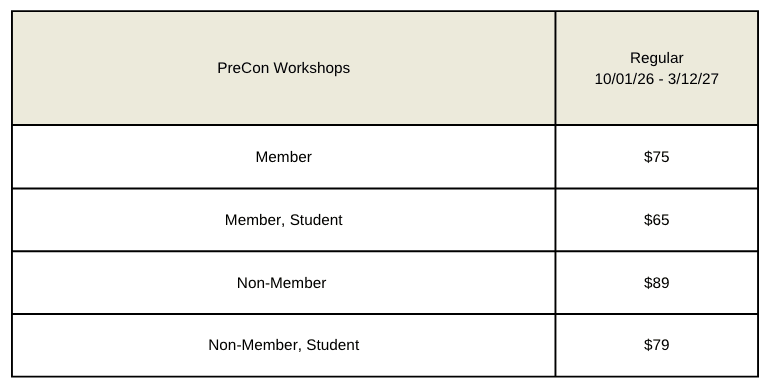
*You must be pre-registered to attend the workshops. There is no on-site registration offered.
Nexus Analysis: A Practical Introduction to Studying Discourse in Action
Workshop Abstract
This workshop is an introduction to nexus analysis – a multidisciplinary, multifaceted exploration
of discourse in action, typically using ethnographic textual, interactional and/or multimodal data.
In their seminal publication, Scollon and Scollon (2004) describe nexus analysis as a way to
examine “the many cycles of discourse that come together to form a nexus of practice” (p. 29).
The nexus of practice is “a point at which historical trajectories of people, places, discourses,
ideas, practices, experiences and objects come together to enable some [social] action”
(Scollon & Scollon, 2004, p. 159). The enabled social action is mediated by three intersecting
cycles of discourse: historical body, interaction order and discourses in place. Many are drawn
toward nexus analysis for its “systematic approach to […] principled eclecticism” (Hult, 2015, p.
217). Nexus analysis has been actively taken up internationally, especially in the fields of
educational and applied linguistics.
In this workshop, participants will learn about the central concepts of nexus analysis and the
basics of the research process. We will begin with an overview of nexus analysis, its origins in
sociology and ethnography and its recent developments. We will then provide a more in-depth
focus on historical body, interaction order and discourses in place as key aspects of nexus
analysis. This will be followed by an exploration of ethnographic discourse analysis, which is the
key data analysis method in nexus analysis. Each aspect will be introduced with a mini-lecture
followed by hands-on activities with authentic data sources. We will conclude by having
participants share their findings from their analysis of historical body, interaction order and
discourses in place together to describe the nexus of practice that emerged. All participants will
receive a list of resources and further reading to use beyond the workshop as they consider
using nexus analysis in their future research.
Workshop Facilitators

Roswita Dressler, PhD, is a Professor and Associate Dean - International at the Werklund School of
Education, University of Calgary. She studies in-service and pre-service teacher understandings of
second language teaching and learning as well as linguistic identity and study abroad. She has used
nexus analysis as a conceptual framework for examining classroom research and study abroad and as a
complementary framework for linguistic landscape analysis. She recently published on nexus analysis in
Canadian Modern Language Review and Journal of Language, Identity and Education.
Elisa Räsänen, PhD, is a University Lecturer at the Language Centre at Aalto University, Finland. She
formerly worked as a Lecturer and Senior Lecturer of Finnish language and culture at Indiana University.
Her research areas are educational linguistics, second and foreign language pedagogy, and language
learning and technology. Räsänen used nexus analysis in her PhD dissertation to study how to support
language learners’ agency in their learning beyond the classroom, in the wild.

Marie Källkvist, PhD, is Professor of English and Language Education at Linnæus University, Sweden. Her
research areas include language learning in multilingual education and language policy and planning in
classrooms, schools and higher education. She has published in the Modern Language Journal, Language
Learning and the International Journal of Bilingual Education and Bilingualism among others. She started
using nexus analysis in collaboration with Francis M. Hult when studying language policy formation in
higher education institutions. Her current nexus analysis research concerns EFL teachers’ policy and
practice in multilingual classrooms and schools.

Pia Lane, PhD, is a Professor of Multilingualism at MultiLing - Centre for Multilingualism in Society
Across the Lifespan at the University of Oslo and Academic Chair for the Circle U. Multilingualism,
Interculturality and Language Lab. She has investigated multilingualism from a range of theoretical
perspectives, primarily drawing on data from Kven and Sámi communities in Northern Norway. Pia Lane
has primarily worked within the framework of nexus analysis and also draws on Indigenous, decolonial
and southern perspectives on multilingualism.
Q-Methodology - Sorting Out Subjectivity: Key Decisions for Designing and Interpreting Q Studies
Workshop Abstract
Q methodology offers applied linguistics a systematic way to study subjectivity and map shared
viewpoints. It does so by combining a structured statement rank ordering task (Q sorting) with
by-person factor analysis (Q method) and interpretive synthesis. Together with its underlying
philosophy, Q is well suited to issues that are complex, tacit, or contested. Because viewpoints
are identified through patterns of shared subjectivity rather than pre-set demographic categories,
Q can render visible minority or marginalized perspectives without deciding in advance who is
marginalized. This aligns closely with applied linguistics as an inter-/transdisciplinary field
oriented to policy, practice, and public understanding: Q helps visualize how different
stakeholders make sense of language-related issues across individual, community, and societal
scales, and it can inform dialogue in contexts where language is entangled with broader societal
struggles.
This Q methodology workshop is structured around the decision-making flowcharts in Q
Methodology in Plurilingualism Studies: Recasting our Methodological Repertoire (Lundberg et
al., forthcoming), using them as a practical route map for designing, conducting, and writing up
Q methodology studies. Workshop participants will work through a sequence of yes/no questions
(Q1–Q18) that visualize the key methodological decisions often left implicit. Decision points are
paired with concrete activities and examples, so participants leave with a scaffolded design
blueprint, a clearer rationale for their choices, and strategies for troubleshooting common
challenges. This workshop is intended to build foundational Q literacy. By the end, participants
should be able to understand Q’s core logic and vocabulary, make informed early-stage design
choices, and critically read Q papers.
Workshop Abstract in Mandarin Chinese:
Q方法论为应用语言学提供了一种系统研究主观性并描绘共享观点的途径。它通过将结构
化的陈述排序任务(Q sorting)与以人为本的因素分析(Q method)及解释性综合相结合
来实现这一点。结合其背后的哲学基础,Q尤其适用于处理复杂、隐性或存在争议的问题
。由于观点是通过共享主观性的模式识别出来的,而非预先设定的人口统计类别,Q能够
在不事先判定谁被边缘化的情况下,使少数或边缘化视角变得可见。这与应用语言学作为
面向政策、实践与公共理解的跨学科/超学科研究领域高度契合:Q有助于在个体、社群与
社会层面可视化不同利益相关者如何理解语言相关议题,并能为语言与更广泛社会困境交
织的情境中的对话与决策提供依据。
本次Q方法论工作坊以 Q Methodology in Plurilingualism Studies: Recasting our
Methodological Repertoire (Lundberg et al., forthcoming) 中的决策流程图为结构主轴,将其
作为设计、实施与撰写Q方法研究的实用路线图。参与者将依次完成一系列是/否问题(
Q1–Q18),以可视化方式呈现那些常被隐含的关键方法学决策。每个决策节点都配有具
体活动与实例,帮助参与者带着脚手架式的研究设计蓝图、更清晰的选择理据,以及应对
常见挑战的排错策略离开。本工作坊旨在建立Q方法的基础素养。到结束时,参与者应能
够理解Q的核心逻辑与术语体系,做出更有依据的早期研究设计选择,并能批判性地阅读
Q方法论文。
Workshop Presenter

Adrian Lundberg is Senior Lecturer at the Department of School Development and Leadership
at Malmö University, Sweden. He has an MA in Languages and Literature: Multilingualism and
Plurilingual Education from the University of Fribourg, Switzerland, and a PhD in Education
from Malmö University, Sweden. Much of his research focusses on investigating stakeholders’
subjective viewpoints about educational issues at the crossroads of multilingualism, equity and
policy. He has guest-edited a special issue on teachers’ beliefs about multilingualism in the
International Journal of Multilingualism and has co-edited Advancing Language Research
through Q Methodology (2024, Multilingual Matters) and Language Policy and Planning (2026,
Bloomsbury Academic). His co-authored book Q Methodology in Plurilingualism Studies:
Recasting our Methodological Repertoire is expected to be published by Routledge in late 2026.