
2027 Virtual Day Plenary
What does "applied" mean in a technological world?
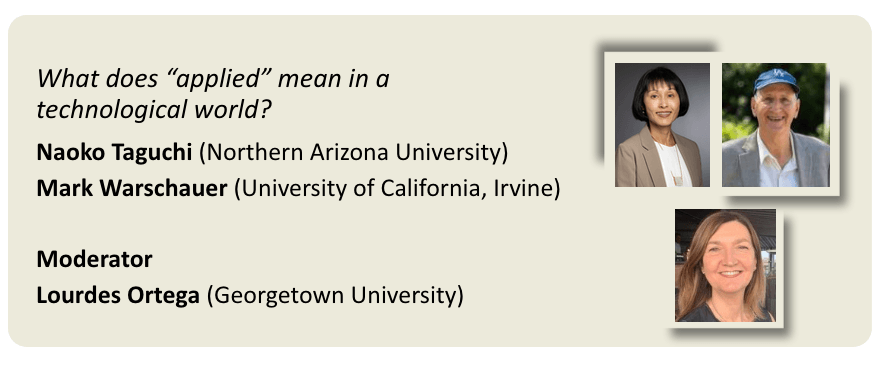
What does “applied” mean in a technological world?
Historically, scholarship has documented how technology has shifted the ways we communicate and engage in meaning-making; these shifts have significant implications for applied linguistics and its research. Notably, Vygotsky’s theory of “mediational means” suggests that online communication does not merely facilitate new kinds of language and literacy practices, but transforms them. Accordingly, the field has moved from an initial paradigm of “computer-assisted language learning” to a focus on digital literacies, including new forms of language and literacy practices such as information literacy and multimodal literacy. This shift also foregrounded social learning, prompting researchers to better understand how computer-mediated communication creates and fosters new opportunities for social learning and to investigate these processes.
However, in a post-digital world—where people routinely engage in social learning through screens—emerging technologies such as artificial intelligence (AI) and virtual reality (VR) are increasingly shaping how applied linguists approach both research and language teaching. The central question, then, is: as these technologies become more prevalent, what does “applied” mean in this evolving technological landscape?
In this plenary dialogue, Mark Warschauer will first address how theory applies to research and teaching in a technologically mediated world. Specifically, it will examine how AI is transforming language and literacy practices not just as a tool, but as a “mediational agent” (Tate et al., 2026) that blurs the boundary between instrument and social partner, requiring new ways of understanding how language learners and their teachers interact with it. This shift creates an urgent need to develop AI literacy for applied linguistics that emphasizes critical awareness, human agency, and reflective, responsible use.
Naoko Taguchi will then focus on how technology has been applied to advance L2 pragmatics research. In this technological world, “applied” involves using tools such as immersive VR to enhance the study of L2 pragmatics. Notably, these environments create realistic, context-rich communication experiences. VR not only supports the development of pragmatic competence but also generates insights that both align with and challenge findings from more traditional research methods in L2 pragmatics.
Finally, Lourdes Ortega will moderate a discussion between the panelists.