AAAL Leadership Updates
December 2025 AAALetter
Table of Contents
- New Opportunities, New Challenges | Ryuko Kubota
- AAAL 2026 Conference Update | Mari Haneda
- AAAL 2026 Virtual Conference: Building Our Global Conversation | Stephanie Link & Peter De Costa
New Opportunities, New Challenges
Ryuko Kubota, University of British Columbia
AAAL President

It has been a few years since the world recovered from the COVID-19 pandemic closures, which devastatingly affected many of us physically, mentally, and professionally. AAAL survived the challenge thanks to the creative strategies and dedicated work of the past leaders, volunteers, and staff. Now, many of us are again facing another challenge arising from the political situation. Many of us have lost funding, struggled to protect academic freedom, and coped with demands for risk management. My Canadian colleagues and students are afraid of traveling to the U.S. to attend our conference. Although this is an unprecedented challenge, AAAL will sustain its resilience and continue to pursue our mission to “promote high-quality and impactful research, professional networking, and intellectual development in all areas of applied linguistics.” Just like we survived the pandemic, we are making innovative efforts to sustain and advance our activities.
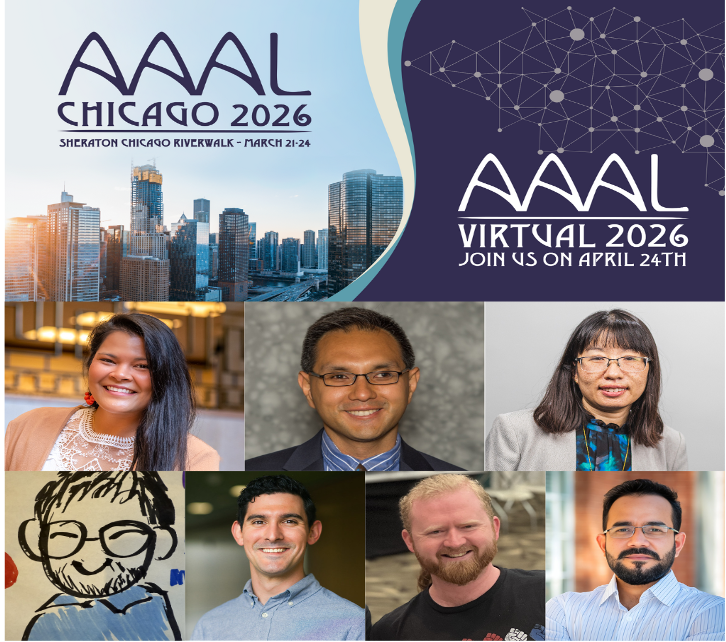
One of the efforts we are making is offering double conferences for the first time—one in person in Chicago, chaired by Mari Haneda (March 21–24, 2026), and another one virtually, co-chaired by Peter De Costa and Steph Link (April 24, 2026). The in-person conference will offer an intimate space for learning from and networking with each other, whereas the virtual conference will provide diverse members with increased accessibility for participation. For more information, see Dr. Link and Dr. de Costa’s article in this issue.
According to our original plan, the virtual conference in 2026 and 2027 will be held on a pilot basis to determine future needs. However, we already see great enthusiasm for the virtual option among members without compromising the level of participation in our in-person conference. Therefore, to keep the momentum, the Online Conference Task Force was established, chaired by Melanie Wong and served by John Wayne dela Cruz, Steph Link, Irasema Mora Pablo, and me. The AAAL Executive Committee (EC) has approved the Task Force’s recommendation to establish a leadership structure and hold a virtual conference again in 2028. According to this arrangement, the President Elect will appoint the Vice Chair of the virtual conference, who will shadow the 2027 virtual conference Co-Chairs (Melanie Wong and me), to serve as the virtual conference Chair in 2028, and to serve as the Past-Chair in 2029. A call for volunteers was announced in November 2025, and we are in the process of appointing the Vice Chair. The EC will continue to explore the possibility of offering the virtual conference on a regular basis.
Offering a virtual conference enhances our JEDI (Justice, Equity, Diversity, and Inclusion) efforts by increasing accessibility to participate. The EC continues to work on new JEDI initiatives and refine existing operations. At the June EC meeting, we approved the new “Standing Rule 10: JEDI Committee” (see AAAL Standing Rules), which establishes a new standing committee and stipulates its membership and activities. Accordingly, candidates for the two elected positions will be nominated by the Nominating Committee for the 2026 election and two other members will be appointed by the Second Vice President. The first JEDI Committee will take office in March 2027. This structure will enable AAAL to address JEDI issues in a stable, sustained manner.
Another ongoing JEDI engagement is to explore ways to further pursue our mission. This summer, I took the initiative to have conversations with a few members who have had diverse opinions about how JEDI has been implemented. Clearly, our scholarship is diverse, addressing various language-related issues. I learned from my conversations that we need to continue to explore what JEDI means to AAAL by asking questions such as: What does JEDI mean to you? If you address social justice issues in your research, does it make you a justice-affirming individual? For instance, if your research focuses on antiracism, does it make you antiracist in everyday actions? If your research does not directly focus on marginalized people or social justice, what does JEDI mean to you in your scholarship and professional life? Then, is JEDI also about our values and dispositions? How should JEDI be implemented—in a directive manner or in a dialogic way? How can inclusion be exercised without creating a feeling of exclusion for some? We will continue to explore these questions.
In addition to our new initiatives, AAAL plans to revise the Promotion/Tenure Guidelines https://www.aaal.org/promotion-and-tenure-guidelines. They were originally adopted in October 2014, revised in March 2015, and again in 2019. The last Task Force recommended revision of the Guidelines every five years. I have formed a Task Force, chaired by Wayne Wright and served by María Cioè-Peña, Christina Higgins, Yasuko Kanno, Charlene Polio, Paul Toth, and Francis Hult (EC liaison). Their report will be discussed in the March EC meeting for adoption.
Finally, I would like to acknowledge that AAAL cannot exist without sponsorship. As new types of support, I would like to thank Multilingual Matters, who will generously make online access to 21 books available for AAAL members. Language Learning has also offered to sponsor a colloquium every other year starting 2027. Duolingo, the Center for Applied Linguistics, and many publishers are also supporting us. Please see articles by Mari Haneda, Steph Link, and Peter De Costa. I would like to express my gratitude for their generous support.
AAAL 2026 Conference Update
Mari Haneda, Pennsylvania State University
AAAL First Vice President and 2026 Conference Chair

President and 2026 Conference Chair
The AAAL 2026 conference will be held at the Sheraton Grand Riverwalk Hotel (March 21-24, 2026). The hotel is in the heart of the River North district, near Michigan Avenue, Millennium Park, Navy Pier, and the Magnificent Mile. The Chicago area is the traditional unceded homelands of the Council of the Three Fires - the Ojibwe, Odawa, and Potawatomi Nations – as well as the home of other tribes such as the Miami, Ho-Chunk, Menominee, Sac and Fox, Kickapoo, and Illinois Nations.
The conference theme is “Reimagining Disciplinary Practices.” While strong disciplinary boundaries can be sources of strength, they can also limit the ability of a field to grow and productively address changing conditions and new challenges. How does applied linguistics remain relevant in the current context of uncertainty characterized by rapid technological change, globalization, climate crisis, intensifying economic inequality, epistemic instability, and deepening ideological divides?
I would like to take this opportunity to thank all of you who make up the association, and particularly those of you who are attending the conference or sharing your work. I extend my deepest gratitude to the AAAL 2026 Conference Planning Team, including Dr. Robert Randez at Northern Arizona University for serving as Conference Program Technician to provide multi-year support; Dr. Kara Morgan-Short at the University of Illinois, Chicago, for coordinating the pre-conference workshops and connecting the planning team with local resources; and the seven wonderful graduate student and faculty volunteers from Pennsylvania State University who have been working to co-create and coordinate different aspects of the conference: Ying Xiong, Nicole Siffrinn, Ty Liu, Merve Özçelik, Ian Thomas Schneider, Pedro Augusto de Lima Bastos, and Grace Benner Kim. I also extend my most sincere thanks to the staff in the AAAL Business Office: Valerie Smith, Hannah O’Dell, Kelsey List, and Alisha Haskell. I would finally like to thank our 57 strand coordinators and 653 reviewers who reviewed submissions for us earlier this summer, a vital part of actualizing the conference. It really takes a village to organize a conference of this scale.
We are continuing the legacy of the most recent conferences (AAAL 2023-2025) as illustrated in the remaining sections. As of November 2025, more than 1,400 people from all over the world have registered for the Chicago conference, with more to come. The Graduate Student Council (GSC) Research Roundtable and social mixer will kick-off the conference Friday evening on March 20 at the conference hotel, and the Pre-Conference Workshops will be held at the University of Illinois, Chicago on the same day. The onsite program begins in the morning of Saturday, March 21. Please see the lineup of plenary speakers and invited colloquia. Register today!
AAAL 2026 will be featuring an array of special sessions and events. During lunch hours and evenings, we will continue offering networking GSC events as well as mentor–mentee opportunities through Conference Connections with dedicated rooms for these events as well as networking for affinity groups.
As in previous years, we will continue to offer an interfaith prayer room for all participants, a lactation room, and a designated family resting and engagement area. We also encourage all attendees to take care of themselves and others while at the venue and request that all participants follow the health and safety guidelines. To make a request for Americans with Disabilities Act accommodations or adjustments, please fill out the form. For professional service requests (special sessions), please fill out the form to be included in the conference program.
Importantly, we want to ask presenters to create inclusive presentations, and you can now find useful inclusive resources based on universal design principles on our AAAL website. On behalf of AAAL and the AAAL 2026 Conference Planning Team, we look forward to seeing you in Chicago in March 2026.
AAAL 2026 Virtual Conference: Building Our Global Conversation
April 24, 2026 | Online
Stephanie Link, Oklahoma State University & Peter De Costa, Michigan State University
The excitement around the inaugural AAAL 2026 Virtual Conference continues to grow! Thank you to everyone who’s already shared your enthusiasm, questions, and ideas. This next step in AAAL’s evolution is not only about format—it’s about reimagining how our community connects, learns, and leads across borders.
With two complementary conferences (in-person in Chicago on March 21–24, 2026, and virtually on April 24, 2026), AAAL 2026 is designed to meet you where you are. Whether you’ll be shaking hands in Chicago or tuning in from across the globe, your participation is part of a shared experiment in inclusion, innovation, and access.
Exploring New Presentation Formats
This year’s virtual conference model expands what scholarly exchange can look like. We’re thrilled to introduce a dynamic range of presentation types to suit diverse ways of sharing and engaging with research. These include:
-
Live Plenary Session: Experience a thought-provoking talk from Shawn Loewen on “Technology and Tasks in Instructed Second Language Acquisition”
-
Four Live Colloquia: Dive deep into collaborative and thematic explorations, designed for real-time dialogue and interaction. Our invited colloquium is:
- Artificial Intelligence in Applied Linguistics: Applications, Promises and Challenges Convened by Andrea Révész, University College London, and Shungo Suzuki, Nagoya University.
-
Special Sessions: Enjoy timely, field-shaping topics that bring together scholars, educators, and practitioners for focused, high-impact discussions. These include:
-
Multilingual perspectives and dialogues with the Ibero-American Association of Applied Linguistics (AIALA)
-
Graduate Student Council Forum
-
Journal Editor Panel
-
-
80 Pre-Recorded Presentations: For presenters and attendees across time zones, these sessions offer flexibility and thoughtful access to high-quality research on demand.
-
16 Live Roundtables: Engage in moderated discussions that blur the boundaries between presenter and participant, encouraging open exchange and collective insight.
-
26 Virtual Posters: Browse, comment, and connect with poster presenters asynchronously.
Together, these formats reflect AAAL’s commitment to accessibility, equity, and innovation—creating an environment where every voice can be heard.
Continuing the Momentum
AAAL 2026 is more than a conference; it’s a conversation in motion. Our dual-format model was born from member feedback and guided by a shared belief that scholarly exchange should be inclusive, flexible, and global. Contributing to this vision is our partnership with Duolingo who will support 32 graduate student scholarships for complimentary registration to the virtual conference. This generous sponsorship helps ensure that emerging scholars from around the world can participate fully in scholarly exchange. Thank you, Duolingo, and thanks to all of you for joining our exciting new era of conferencing. Register for the conference here.